Introduction: The Patient Revolutionaries
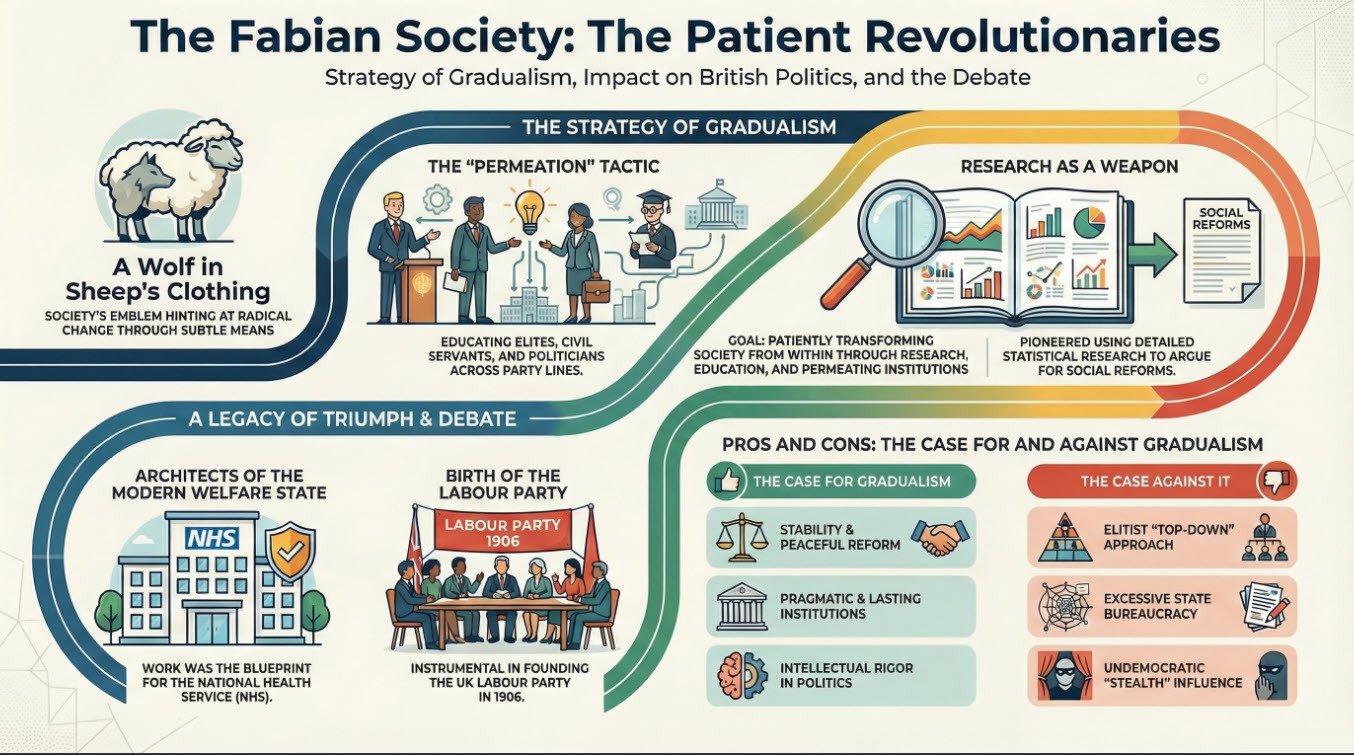
In the turbulent landscape of modern politics, few organizations have wielded as much quiet, persistent influence as the Fabian Society. Unlike revolutionary movements that seek to overthrow systems in a dramatic upheaval, the Fabians have always championed a different path: the "inevitability of gradualism." This is the story of a society of intellectuals, activists, and policymakers who believed that the best way to achieve a socialist society was not through sudden revolution, but through patient, persistent persuasion from within. Their emblem—a wolf in sheep's clothing—hints at their unique and often misunderstood strategy.
The Origins: A Meeting of Minds in Victorian England
The Fabian Society was founded in London in 1884, in the wake of an earlier fellowship group. Its name was derived from the Roman general Quintus Fabius Maximus Verrucosus, nicknamed "Cunctator" ("the Delayer"). Fabius was famous for his patient, attrition-based warfare against Hannibal, avoiding direct battles to wear down a stronger enemy. The early Fabians saw this as the perfect metaphor for their political strategy: they would not confront capitalism head-on but would work to gradually transform it through reasoned argument, education, and permeation of existing political institutions (Cole, 1961).

The Foundational Figures
The Society's early strength came from a remarkable group of intellectuals, including:
- George Bernard Shaw: The famed playwright was a leading pamphleteer and charismatic voice for the Society.
- Sidney and Beatrice Webb: This powerhouse couple were the indefatigable researchers and administrators. They co-founded the London School of Economics (LSE) in 1895 to further the study of social sciences from a Fabian perspective.
- H.G. Wells: The visionary author was a later, though sometimes critical, member who contributed to its intellectual debates.
- Annie Besant: A prominent social reformer, socialist, and women's rights activist.
The Fabian Strategy: Permeation and Gradualism
The Fabian Society's core doctrine rejected Marxist revolutionary class struggle. Instead, they advocated for a "permeation" strategy, which involved:
- Evidence-Based Research: The Fabians were pioneers in using detailed, statistical research to make their case for social reform, publishing a vast collection of influential pamphlets and essays.
- Educating the Elite: They aimed to convince intellectuals, civil servants, and politicians across party lines of the rationality of socialist principles.
- Working Within the System: They believed in achieving change through parliamentary democracy, legislation, and the establishment of public institutions.
Their most famous early publication, Fabian Essays in Socialism (1889), edited by George Bernard Shaw, laid out their vision for a socialist state achieved through democratic means.
The Birth of the Labour Party and the Welfare State
The Fabian Society's most tangible and lasting impact was its instrumental role in the foundation of the UK Labour Party. In 1900, the Society, along with trade unions and other socialist groups, helped form the Labour Representation Committee, which became the Labour Party in 1906. The Fabians provided the fledgling party with much of its intellectual and policy framework (Pugh, 1993).
This influence came to full fruition after World War II. The landmark 1945 Labour Government, under Clement Attlee, was a Fabian triumph. Many of its ministers, including Attlee himself, were Fabians. The government implemented the core pillars of the modern welfare state, largely inspired by the lifelong work of the Webbs and their colleagues:
- The National Health Service (NHS)
- The expansion of National Insurance
- The nationalization of key industries like coal, rail, and steel.
The Beveridge Report of 1942, which laid the blueprint for the welfare state, was steeped in the kind of detailed, reformist thinking the Fabians had championed for decades.
Influential Members and Global Reach
The Society's influence extended far beyond its founding members. Throughout the 20th and 21st centuries, it has been a breeding ground for Labour Party leadership and progressive thinkers.
- Prime Ministers: Ramsay MacDonald, Clement Attlee, Harold Wilson, Tony Blair, and Gordon Brown were all members.
- Intellectuals and Leaders: R.H. Tawney, and Anthony Crosland. The Society also boasts international affiliates, with Jawaharlal Nehru of India being a notable member who incorporated Fabian ideas into the development of independent India.
List of Members
The Fabian Legacy: A Balanced View of Pros and Cons
The Fabian Society's approach to political change is not without its critics. Its legacy is a complex tapestry of celebrated achievements and significant criticisms.
Pros and Advantages
- Stability and Avoidance of Violence: By rejecting revolutionary upheaval, Fabianism provided a peaceful, democratic path to social reform. This prevented the kind of violent conflicts that marred socialist movements in other countries and ensured continuity of governance (McBriar, 1962).
- Pragmatic and Achievable Reforms: The focus on gradual, evidence-based policy led to tangible, lasting institutions. The NHS is often cited as one of the greatest achievements of British social policy and a direct result of the Fabian-influenced 1945 government.
- Intellectual Rigor: The Society's commitment to research and education raised the quality of political discourse and policy-making, moving it away from pure ideology and towards practical solutions.
- Successful Permeation of Institutions: The strategy worked. By embedding their ideas in universities, civil service, and major political parties, Fabians achieved a level of influence that revolutionary groups never could.
Cons and Criticisms
- Elitism and a "Top-Down" Approach: Critics, including some on the left, argue that the Fabian strategy is inherently elitist. It relies on enlightened intellectuals and bureaucrats designing society for the masses, rather than fostering mass, grassroots revolutionary consciousness (Milburn, 2007).
- Excessive Bureaucracy: The Fabian vision of a state-managed society has been criticized for leading to large, inefficient, and impersonal bureaucracies that can stifle individual freedom and innovation.
- Accommodation with Capitalism: From a more radical socialist perspective, the Fabian strategy is seen as a capitulation to capitalism. By seeking to reform rather than replace it, critics argue they merely created a more humane form of capitalism without addressing its fundamental power imbalances and exploitative nature.
- Stealth and Lack of Transparency: The "permeation" tactic has often been framed by opponents as a stealthy, undemocratic takeover of institutions by a small, unelected group, giving rise to serious debate about their influence.
Conclusion: The Enduring Power of an Idea
From a small gathering of Victorian idealists to a cornerstone of the British political establishment, the Fabian Society's journey is a testament to the power of ideas, persistence, and strategic patience. The debate over its methods—the pros of stable, pragmatic reform versus the cons of elitism and bureaucratic overreach—continues to define discussions about social democracy today. Whether one views them as wise architects of the welfare state or as paternalistic elitists, their impact is undeniable. The very concept of a government-guaranteed social safety net and the state's role in managing the economy all bear the fingerprints of the Fabian "gradualists." They proved that with enough research, persuasion, and patience, a radical idea can become the new common sense.
References and Further Reading
- Cole, M. (1961). The Story of Fabian Socialism. Stanford University Press.
- McBriar, A. M. (1962). Fabian Socialism and English Politics, 1884-1918. Cambridge University Press.
- Pugh, P. (1993). Educate, Agitate, Organize: A Century of Fabian Socialism. Methuen.
- Shaw, G. B. (Ed.). (1889). Fabian Essays in Socialism. The Fabian Society.
- Milburn, K. (2007). "The Fabian Society: A Study in the Permeation of Policy." In Global Social Movements: A Reader. Routledge.
- The Fabian Society. (n.d.). Our History. Retrieved from https://fabians.org.uk/about/our-history/
If you require assistance with this article, please contact us.
Please see our disclaimer
