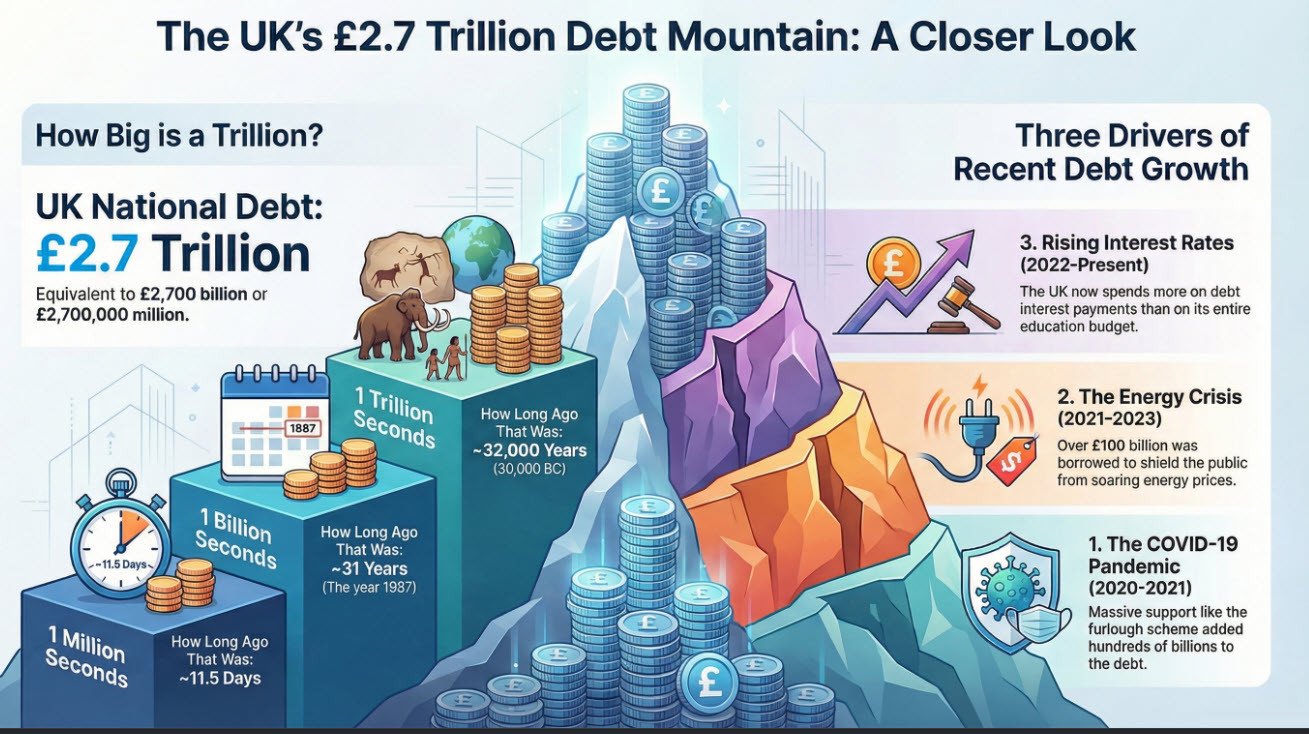
The United Kingdom’s public sector net debt stands at an almost unfathomable £2.7 trillion, and rising. Yes, you read that correctly. While many suspect the figure is over one trillion, the reality is more than double that. This number is so colossal that it becomes abstract—a mere statistic that’s hard to visualise or comprehend. But understanding this debt, how we got here, and what these figures truly mean is crucial for every citizen.
First, Let's Grasp the Scale: From Million to Trillion
To make sense of £2.7 trillion, we need to break down the number hierarchy. Our brains are wired to understand thousands, but millions, billions, and trillions are different beasts entirely.
- One Million (£1,000,000): This is a substantial amount, but still relatable. Imagine buying a spacious family home in many parts of the UK. One million seconds ago was roughly 11.5 days.
- One Hundred Million (£100,000,000): Now we're entering lottery win territory. This could fund a large secondary school or a significant infrastructure project. One hundred million seconds ago was about 3.2 years.
- One Billion (£1,000,000,000): This is where scale dramatically shifts. One billion is one thousand millions. It's comparable to the annual budget of a mid-sized UK city council. One billion seconds ago was 1987—over 31 years.
- One Trillion (£1,000,000,000,000): This is the key to our national debt. One trillion is one thousand billions, or one million millions. It is an astronomically different scale. One trillion seconds ago was 30,000 BC, during the last Ice Age.
So, the UK's £2.7 trillion debt stack is equivalent to 2,700 billion, or 2,700,000 million. Visualise it as a stack of £1 coins: £1 trillion in £1 coins would stretch to the moon and back—twice. Our debt would make that journey over five times.
Why Has the UK's Debt Skyrocketed in the Last Five Years?
The journey from approximately £1.8 trillion in early 2019 to £2.7 trillion today is a story of unprecedented sequential crises. Here are the primary drivers:
- The COVID-19 Pandemic (2020-2021): This was the single biggest shock. The government implemented massive, essential support schemes like the furlough programme (costing over £70 billion), business grants, and the Eat Out to Help Out scheme. Simultaneously, tax revenues plummeted due to locked-down economies. The government essentially borrowed to keep the country and its economy on life support, adding hundreds of billions to the debt in just 24 months.
- The Energy and Cost of Living Crisis (2021-2023): Just as the pandemic receded, the war in Ukraine triggered a global energy shock. Soaring gas and electricity prices threatened to collapse businesses and freeze households. The government's response, including the universal Energy Price Guarantee and subsequent targeted support, required further borrowing of over £100 billion to shield the public from the worst of the price spikes.
- Rising Interest Rates (2022-Present): A critical and often overlooked factor. For years, the government borrowed at historically low interest rates (often below 1%). However, as the Bank of England raised rates to combat post-pandemic inflation, the cost of servicing (paying interest on) the existing debt exploded. Astonishingly, the UK now spends more on debt interest than it does on education. This is a structural drain on the public finances that locks in higher spending for years to come.
- Underlying Pressures and Economic Stagnation: Beneath these shocks lie longer-term challenges: an aging population increasing demands on health and social care, years of relatively low economic growth limiting tax revenue increases, and pre-existing fiscal pressures. A slower-growing economy means the debt burden feels heavier.

What Does This Mean for the Future?
A high national debt isn't necessarily an immediate crisis for a government that controls its own currency, but it carries significant consequences. It limits fiscal flexibility, meaning less room for future tax cuts or spending increases on public services. A large portion of tax revenue is pre-committed to debt interest, diverting funds from hospitals, schools, and infrastructure. It also creates vulnerability to future economic shocks and can place upward pressure on taxes in the long term.
What next - 3 Trillion?
The £2.7 trillion figure is more than a headline; it's a reflection of the turbulent era we have lived through. Understanding its scale—from the tangible concept of a million to the ice-age-spanning reality of a trillion—is the first step in grasping the profound economic choices that lie ahead for the UK. The debate on how to manage this debt, while fostering growth and maintaining public services, will define the nation's economic trajectory for a generation.
If you want assistance with this article, please Contact Us
