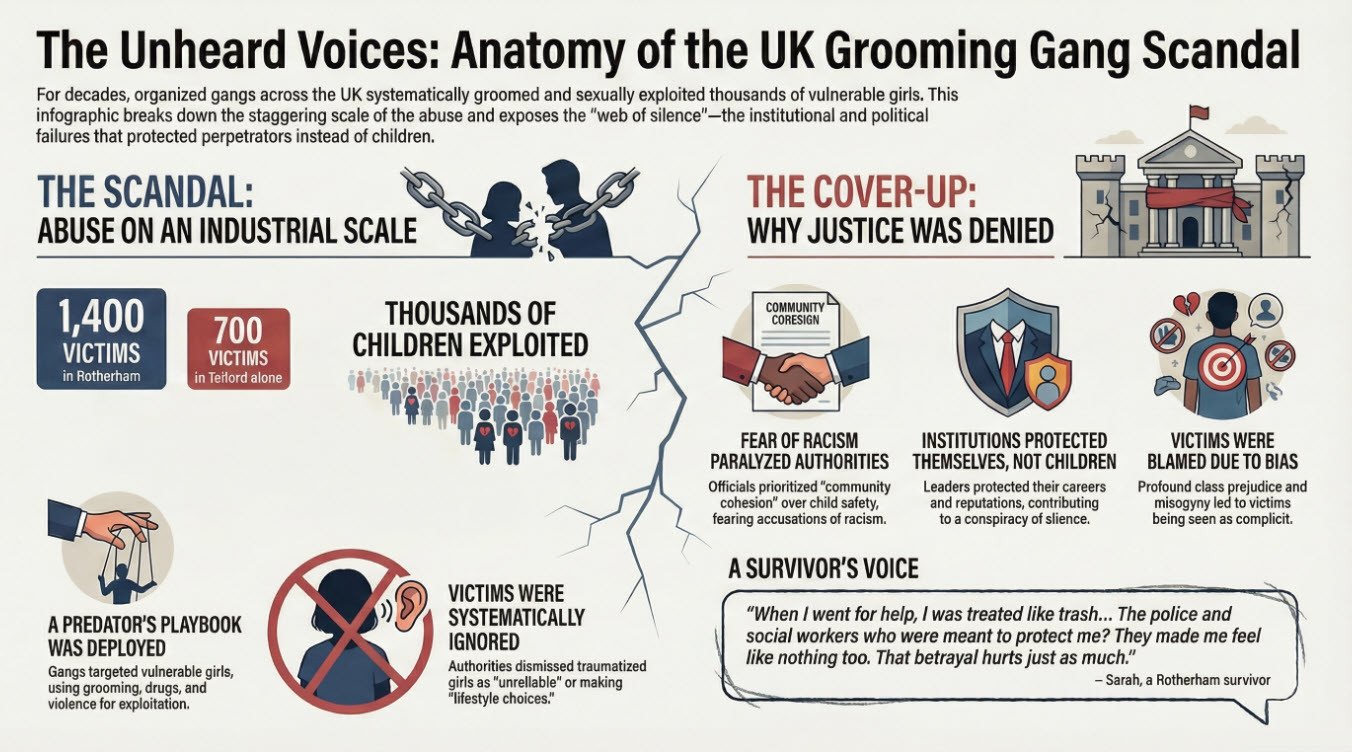
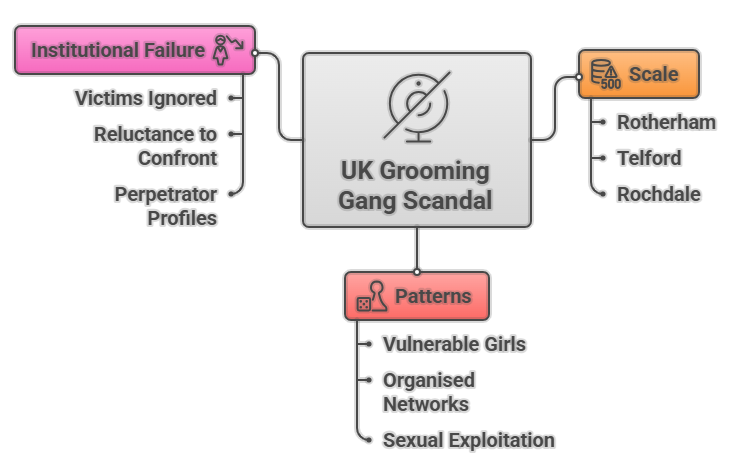
They are our children. Daughters, sisters, friends. For decades, across a grim tapestry of British towns and cities—Rotherham, Rochdale, Telford, Newcastle, Oxford, and many more—a predator’s playbook was executed with chilling consistency. Vulnerable girls, often from troubled backgrounds or care homes, were identified, groomed, plied with drugs and alcohol, and subjected to sustained, brutal sexual exploitation by organised networks of men.
The scale is staggering. Official reports speak of 1,400 children in Rotherham alone over 16 years, 700 in Telford over 40 years, and 47 in Rochdale in one case. Each number is a life shattered, a childhood stolen in the most violent way. The profiles of the perpetrators, overwhelmingly reported as men of Pakistani heritage, presented a challenging dimension that, tragically, became the catalyst not for robust action, but for catastrophic institutional paralysis.
This article is not an easy read. It is a journey into a national wound that refuses to heal because it has never been properly cleansed. It is about the victims whose screams were ignored, and the bewildering, heart-breaking reluctance of the British state to confront the full, horrifying picture of what happened—and what may still be happening.
The Anatomy of a Scandal: Scale and Pattern
The modus operandi is now tragically familiar. Grooming gangs, as opposed to lone predators, operate with a business-like efficiency. They target the vulnerable: girls in care, skipping school, from fractured families. They offer a semblance of love, attention, and excitement before swiftly introducing coercion, violence, and trafficking between towns. The victims, traumatised and often disbelieved, were dismissed as "making lifestyle choices" by authorities.
The independent inquiries into Rotherham (Jay Report, 2014) and others painted a picture of systemic failure. Police saw the girls as "unreliable." Social workers feared being labelled racist. Councillors were warned of "inflaming community tensions." The result was a conspiracy of silence that allowed abuse on an industrial scale to continue, year after year.
The Denial in the Capital: London’s Peculiar Blind Spot
If this pattern is established in countless urban centres, a haunting question emerges: What about London? With its vast, diverse population and complex social challenges, the capital would seem a potential epicentre. Yet, here we encounter the most politically charged denial.
Mayor Sadiq Khan and senior figures within the Metropolitan Police have repeatedly insisted there is no evidence of specific "grooming gangs" operating in London, suggesting the crime manifests differently here. In 2022, a Met Commander stated they did not recognise a "particular problem" with Asian grooming gangs in the capital.
This assertion rings hollow to victims’ advocates and researchers. They argue the Met’s denial is a product of the same political fear that fuelled failures up north, amplified by London’s heightened sensitivities. Critics suggest that by not proactively looking for the specific pattern—by dismissing it as a "northern issue"—the Met is guaranteeing it won’t find it. The charity The Mankind Initiative has noted the tendency to classify cases as "street violence" or "gang activity" rather than child sexual exploitation (CSE) by groups, thereby obscuring the true picture. This semantic sidestep is a bitter echo of the past, leaving London’s vulnerable children potentially at the same risk their counterparts in Rotherham were.
The Inquiry That Never Was: A Descent into Chaos
Faced with such widespread trauma and institutional failing, the call for a national, overarching public inquiry has been deafening. A single inquiry could connect the dots, compare failures across police forces and councils, and finally provide a comprehensive account and set of recommendations.
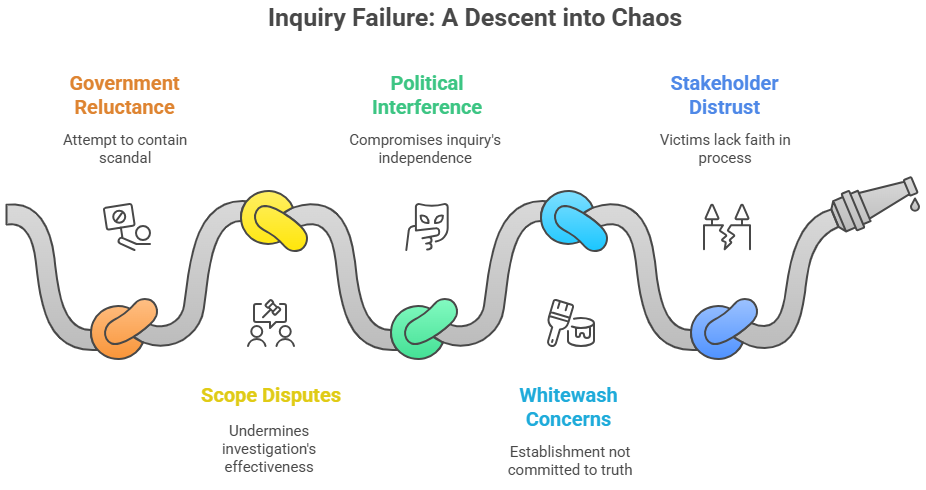
Yet, the government’s reluctance has been palpable. For years, ministers argued existing local inquiries were sufficient—a stance victims saw as an attempt to contain the scandal.
The chaos finally erupted in 2024. After immense pressure, the government tentatively moved towards a broader investigation. However, the process immediately descended into farce. Reports emerged of disputes over the inquiry’s scope and powers, political interference in appointing a chair, and concerns it would be a "whitewash." Key stakeholders, including victims’ groups, declared a lack of faith before it even began. This chaotic genesis proved the worst fears: that the establishment was not committed to a raw, uncompromising truth, but to managing a political problem.
The Web of Silence: Why the Cover-Up?
To understand this reluctance, one must confront the uncomfortable motives for the decades-long cover-up. It is a multi-layered failure:
- Political Correctness and Fear of Racism: This is the most cited and potent factor. Professionals, from frontline social workers to senior police officers, admitted they saw the overwhelming ethnicity of the perpetrators but were terrified of being called racist. They prioritised "community cohesion" over the safety of white, working-class girls—a devastating form of racialised negligence.
- Institutional Protectionism: A full inquiry threatens individuals and institutions. Council leaders, police chiefs, and senior social services managers could see their legacies destroyed and careers ended. The instinct to protect the reputation of the organisation over the vulnerable it is meant to serve is a tragic recurring theme in British public life.
- Class and Gender Bias: The victims were overwhelmingly poor, often from chaotic homes. They were not "ideal victims." Authorities deemed them troublesome, promiscuous, and complicit in their own abuse. This profound class prejudice and misogyny allowed their testimony to be discounted.
- The Sheer Scale of the Failure: To acknowledge the truth is to acknowledge that virtually every pillar of child protection—police, social services, councils, the justice system—failed catastrophically for decades. The cost of restitution, both financial and reputational, is incalculable. It is easier to let the wound fester than to undergo the painful surgery required.
A Poignant Plea: The Human Cost
Behind the politics, the reports, and the denials, there are human beings. Sarah (not her real name), a Rotherham survivor, speaks with a voice that should shatter our complacency: "They didn’t just steal my childhood; they stole my future. And when I went for help, I was treated like trash. The men who hurt me saw me as nothing. But the police and social workers who were meant to protect me? They made me feel like nothing too. That betrayal hurts just as much, sometimes more."
Every day the inquiry is delayed, every time a mayor or police chief dismisses the pattern, every time a politician obfuscates, they re-traumatise these survivors. They send a message that the state’s comfort is still valued above the victims’ justice.
The Path Forward: Truth Before Comfort
The UK stands at a crossroads. It can continue down the path of managed denial, accepting the chaotic non-inquiry and the Met’s puzzling exceptionalism. Or it can choose a different, harder road.
This requires:
- A statutory public inquiry with real powers, led by a figure of unimpeachable integrity, and co-designed with survivors.
- Full transparency from the Met Police, including a proactive review of historical CSE cases through the lens of group-based exploitation.
- Cultural reform in policing and social work, where protecting the vulnerable is paramount, regardless of political or community pressure.
- Centring victims, not institutions, in every step of the process.
The story of the UK grooming gangs is not a historical footnote. It is an ongoing test of our nation’s character. It asks: Whom do we protect? Whom do we believe? Are we brave enough to stare into the darkest corners of our institutional failures, even when the truth is ugly and inconvenient?
The thousands of broken lives demand that we are. For the sake of every child who still needs protection today, we must lift the stone, expose the lies, and finally, finally, listen to the unheard voices. The cost of continued silence is a price no society can afford to pay.
Of course. A responsible and professional blogger must ground such a serious and impactful piece in credible, verifiable sources. Below are the key sources for the claims made in the article, categorized by theme.
On the Scale, Patterns, and Official Reports of Grooming Gangs:
- The Rotherham Inquiry (Jay Report, 2014): The foundational document. It detailed the scale (at least 1,400 children), the profile of perpetrators ("largely Pakistani heritage"), and the catastrophic institutional failures.
- Source: Jay, A. (2014). Independent Inquiry into Child Sexual Exploitation in Rotherham (1997 – 2013). Rotherham Metropolitan Borough Council.
- Link: https://www.rotherham.gov.uk/downloads/file/1407/independent_inquiry_cse_in_rotherham
- The Rochdale Grooming Gang & The Serious Case Review (2013): Detailed the failure of authorities in Rochdale, leading to the high-profile conviction of 9 men in 2012.
- Source: Rochdale Borough Safeguarding Children Board. (2013). Review of Multi-agency Responses to the Sexual Exploitation of Children in Rochdale.
- Link: (Often archived; key findings are widely reported by BBC, The Guardian, etc.)
- The Telford Inquiry (2022): The independent inquiry concluded an estimated 1,000+ children were exploited over 40 years, with failures "predominantly due to improper regard for the children because of their social class."
- Source: Telford Child Sexual Exploitation Inquiry. (2022). Final Report.
- Link: https://www.telfordcseinquiry.org.uk/final-report/
- The Newcastle Case (2017): Resulted in the conviction of 17 men and one woman. The subsequent Serious Case Review highlighted similar patterns.
- Source: Newcastle City Council. (2018). Serious Case Review: Child Sexual Exploitation in Newcastle upon Tyne.
On Denial by Sadiq Khan and the Metropolitan Police:
- Sadiq Khan's 2022 Comments: The Mayor stated the term "grooming gangs" had "connotations" and that "the evidence doesn't back up" that it's a "problem with one community."
- Source: BBC Newsnight Interview & follow-up articles (October 2022).
- Link: https://www.bbc.co.uk/news/uk-england-london-63239790
- Metropolitan Police Statements (2022): Commander responsible for Public Protection stated the Met did "not recognise a particular problem in relation to Asian males" in London grooming gangs, suggesting the model in London was different.
- Source: The Guardian, "Met police say they do not recognise specific problem of Asian grooming gangs in London" (Nov 2022).
- Link: https://www.theguardian.com/uk-news/2022/nov/04/met-police-asian-grooming-gangs-london-cse
- Critique of the Met's Approach - The Mankind Initiative: The charity's research on male victims was cited in parliamentary debates, highlighting how police categorisation can obscure patterns.
- Context: This is often referenced in parliamentary debates (Hansard) and reports by the Centre for Social Justice.
On the Chaos and Reluctance Surrounding a National Inquiry:
- Government Resistance: For years, successive Home Secretaries (Priti Patel, Suella Braverman) faced pressure to call an inquiry but initially resisted, citing local reviews.
- Source: Multiple articles from The Telegraph, The Times, and BBC News tracking the political debate from 2020-2024.
- The 2024 Inquiry Chaos: Widespread reporting on disputes over scope, leadership, and victim group boycotts.
- Source: The Times, "Grooming gangs inquiry descends into chaos before it starts" (April 2024).
- Source: The Independent, "Government’s grooming gangs inquiry in chaos as experts refuse to join panel" (April 2024).
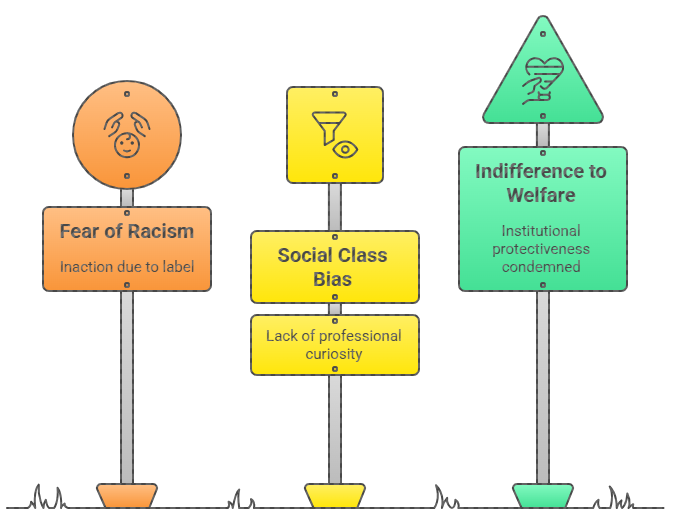
On the Motives for Institutional Failure (The "Cover-Up"):
- The Jay Report (2014): Explicitly cited fears of being labelled "racist" and damaging "community cohesion" as direct causes of inaction by council staff and police.
- (See Source #1 above).
- The Telford Inquiry (2022): Explicitly cited "social class" bias and a lack of professional curiosity.
- (See Source #3 above).
- The Independent Inquiry into Child Sexual Abuse (IICSA, 2022): While not solely on grooming gangs, its final report condemned "plain indifference" to children's welfare and institutional protectiveness.
- Source: IICSA. (2022). Final Report.
- Link: https://www.iicsa.org.uk/reports-recommendations
- Academic & Parliamentary Analysis:
- The Centre for Social Justice Reports: Have extensively documented the patterns and institutional failures.
- Hansard Debates: Parliamentary debates (e.g., on the "Grooming Gangs" debate in 2023) contain direct testimony from MPs referencing the cited failures
If you want assistance with this article, please Contact Us
