If you picture Britain’s prison crisis, you likely imagine overcrowded cells, violence, and squalor. While that reality is tragically accurate, it’s only half the story. A deeper, more paradoxical scandal unfolds out of the headlines: a system simultaneously bursting at the seams and hemorrhaging money into empty, crumbling buildings. From the echoing halls of Dartmoor to catastrophic administrative blunders and a ballooning foreign national population, the UK’s penal system is not just in crisis—it’s a masterclass in systemic failure, wasting resources and endangering public safety every single day.
Part 1: The Ghost Jails - A Scandal of Empty Cells and Wasted Millions
Amidst a prison population pushing 88,000, the existence of wholly or partially empty prisons seems unthinkable. Yet, it is a costly reality.
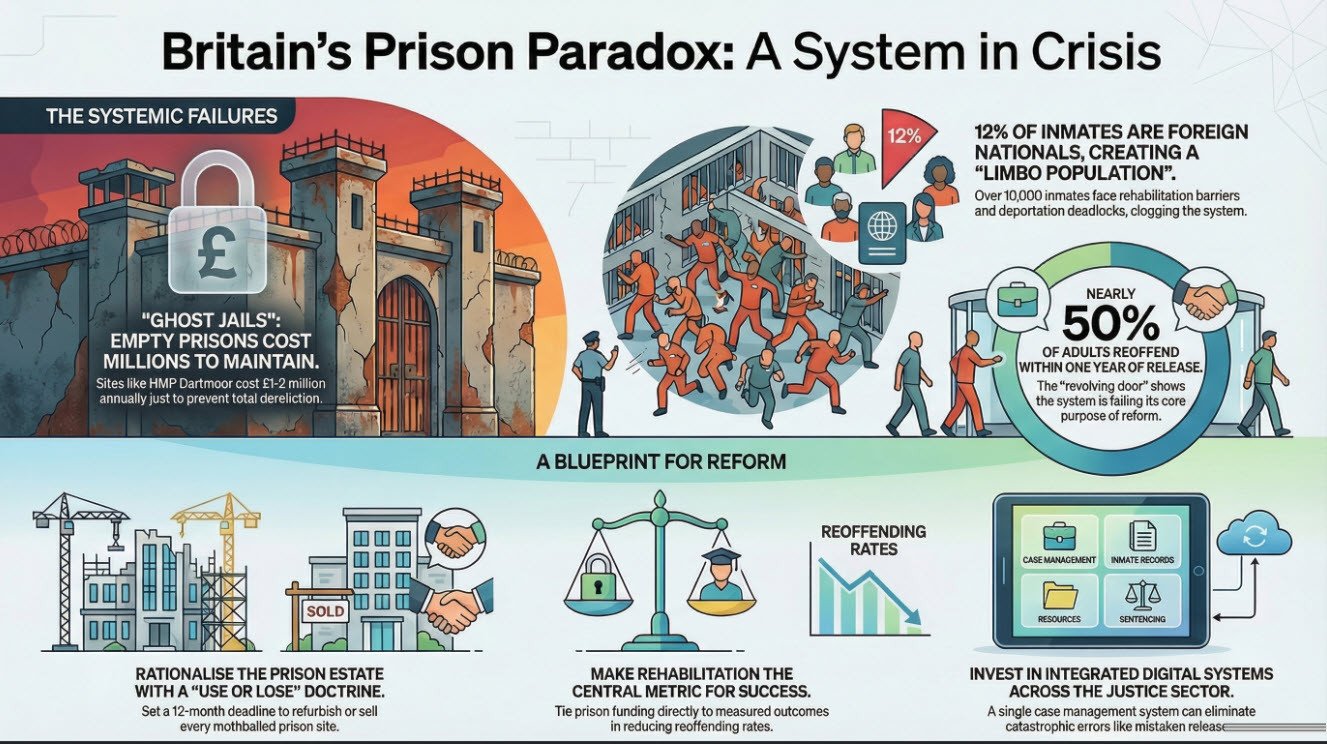
HMP Dartmoor, Princetown, the iconic 1809 granite fortress, is a flagship example. Slated for closure but in a state of limbo, its capacity has been slashed. Large wings are mothballed, yet the taxpayer funds 24/7 security, essential maintenance, and heating for the sprawling, listed complex on the harsh moor—an annual bill estimated at £1-2 million just to prevent total dereliction.
It’s not alone. HMP Dorchester, closed as a functioning jail in 2013, remains in government hands, used sporadically for filming while accruing continuous security and maintenance costs. HMP Reading languished empty for six years before its eventual sale, with holding costs likely surpassing its final price. Beyond these names, partial mothballing is rife; wings are decommissioned inside "operational" prisons, still consuming resources but yielding no rehabilitative return.
The Root of the Waste: This inertia stems from political indecision (fearing "soft on crime" headlines), the challenges of redeveloping listed buildings, and a critical lack of a coherent, long-term estate strategy. The result is a double failure: vast sums are spent to maintain decay, while the opportunity to repurpose assets or invest in modern facilities is lost.
Part 2: The Unforced Errors - Mistaken Releases and a System in Chaos
The phenomenon of prisoners being "released by mistake" is a shocking indicator of a system buckling under pressure. These are not escapes, but catastrophic failures of process—paperwork errors, miscommunication between courts and prisons, and human error within overworked teams. Official data reveals several hundred such incidents in recent years.
Each event is a profound breach of public security, a betrayal of victims, and a demoralising blow to staff. It points to antiquated IT systems, unsustainable workloads, and dangerous fragmentation across the justice sector. When the state cannot reliably perform its most basic function—securely detaining those it has sentenced—its fundamental competence is called into question.
Part 3: The Limbo Population - The Complex Reality of Foreign Nationals
A staggering 12% of the prison population (over 10,000 people) are foreign nationals, representing over 170 countries. Their presence creates immense, often ignored, complexities:
- Rehabilitation Barriers: Language and cultural hurdles block access to offending behaviour programmes and education, making warehousing the default.
- Deportation Deadlock: Many complete their criminal sentence only to remain incarcerated under immigration powers, as the Home Office struggles to arrange removals. This clogs cells that should ease the overcrowding crisis.
- International Failure: The UK’s inability to secure more prisoner transfer agreements means we incarcerate individuals at UK expense, with little chance of preparing them for reintegration abroad.
Part 4: The Vicious Cycle - Violence, Drugs, and the Failure to Reform
These specific crises exist within a broader ecosystem of failure:
- Sky-High Violence: Record levels of assaults are fueled by idleness, desperation, and the pervasive availability of drugs.
- The Spice Epidemic: Psychoactive substances have created a crisis of control, health, and coercion within walls.
- The Revolving Door: With nearly 50% of adults reoffending within a year, the system is demonstrably failing its core purpose. Overcrowded, violent, and drug-ridden prisons are academies of crime, not engines of reform.
A Blueprint for Reform: From Warehousing to Justice
This multi-faceted crisis demands a radical, coherent overhaul, not more piecemeal tinkering. In our opinion, the following might help reduce the huge challenges that are faced.
1. Rationalise the Estate: The 'Use or Lose' Doctrine.
Set a strict 12-month deadline for every mothballed site. Either commit capital to fully refurbish it for a specific, modern rehabilitative purpose (e.g., a dedicated drug treatment prison) or accelerate its sale. Embrace innovative reuse for historic sites—following Shepton Mallet’s model as a distillery and heritage attraction—to turn liabilities into community assets.
2. Overhaul the Foreign National Pipeline.
Prioritise and fund new Prisoner Transfer Agreements. Create dedicated, language-specific units focused on deportation and home-country reintegration. Break the administrative deadlock between the MoJ and Home Office.
3. Eliminate Catastrophic Errors Through Integration.
Invest in a single, integrated digital case management system across courts, prisons, and probation. Introduce a mandatory, final "gate-check" protocol managed by a senior officer to stop mistaken releases at the cell door.
4. Make Rehabilitation the Central Metric.
Tie prison funding to measured outcomes in reduced reoffending. Guarantee minimum hours of education, skills training, or therapy. Radically expand Release on Temporary Licence (ROTL) to allow lower-risk inmates to secure jobs and housing before release, breaking the cycle of homelessness and crime.
5. Divert to Decriminalise.
For low-level, non-violent offences driven by addiction or mental health, invest in problem-solving courts and community sentences that address root causes. Stop using prison as a default for social failure.
Conclusion: A Choice of Legacy
The empty shells of Dartmoor and Dorchester, the scandal of mistaken releases, and the limbo of foreign nationals are not isolated issues. They are interconnected symptoms of a system that has lost its purpose, vacillating between negligent waste and punitive overcrowding.
The solutions require political courage and long-term investment. Yet the cost of inaction—continued high crime, shattered lives, and a justice system that erodes public trust—is immeasurably higher. We must choose: will we continue to fund warehouses of neglect, or will we build a system focused on justice, safety, and redemption? The future of community safety depends on the answer.
A Disclaimer: For important information regarding the sourcing, purpose, and limitations of this content, please refer to the full disclaimer located in the footer of this website..
If you want assistance with this article, please Contact Us
