Published: January 11, 2026 | Reading time: 7 minutes
Key Takeaways:
> - The right UK Authority: Use the core split between National Government (laws, taxes, welfare) and Local Government (bins, roads, planning) to instantly categorize 80% of your issues.
> - Navigate complex local structures (two-tier, unitary, combined authorities) by using a simple decision-tree flowchart to target the exact council department.
> - For local service failures (bins, potholes), start with your council's official procedure; escalate to a local councillor or the Local Government Ombudsman if needed.
> - For national policy issues (benefits, immigration), your MP is the primary contact to raise matters with central government departments like the DWP or Home Office.
> - For systemic/funding issues (library closures), employ a dual strategy: contact your local councillor for local impact and your MP to challenge national funding settlements.
Table of Contents
How Do You Know Whose Door to Knock On? Your UK Authority Complaint Flowchart
Ever spent an afternoon fuming because your bin wasn't collected, only to get lost in a maze of council departments and government websites trying to find who's actually responsible? You're not alone. Across forums like Reddit's r/AskUK, the same questions pop up daily: 'My street's full of potholes, who fixes it?', 'Who do I challenge about this planning permission?', or simply, 'Why is this so complicated?'.
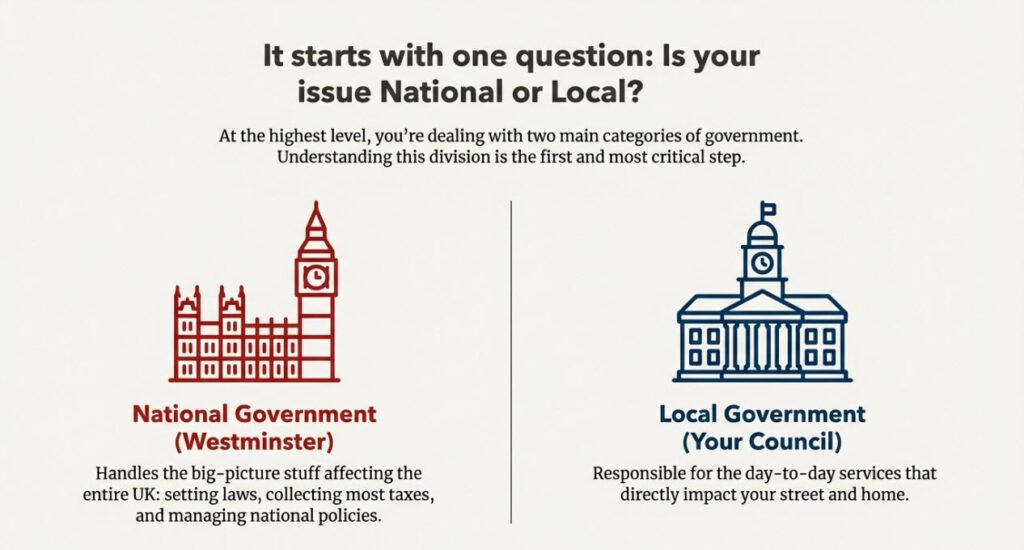
This confusion is the first, biggest hurdle to getting anything fixed. The core of the problem is not knowing which 'government' is in charge of your specific issue, leading to wasted time and a lot of phone calls that go nowhere. The good news is, there's a simple starting point to cut through the noise, and it all comes down to one fundamental split.
At the highest level, you're dealing with two main categories: National Government and Local Government. Understanding this division instantly clears up about 80% of the 'who does what?' mystery. Westminster and its central departments handle the big-picture stuff that affects the entire UK, like setting laws, collecting most taxes (think Income Tax and VAT), and managing national policies on defence, immigration, and welfare benefits. Your local council, on the other hand, is responsible for the day-to-day services that directly impact your street and home.
They're the ones you need for missed bin collections, reporting potholes on local roads, applying for school places, and navigating local planning rules. Getting this first step right means you're already halfway to a resolution.
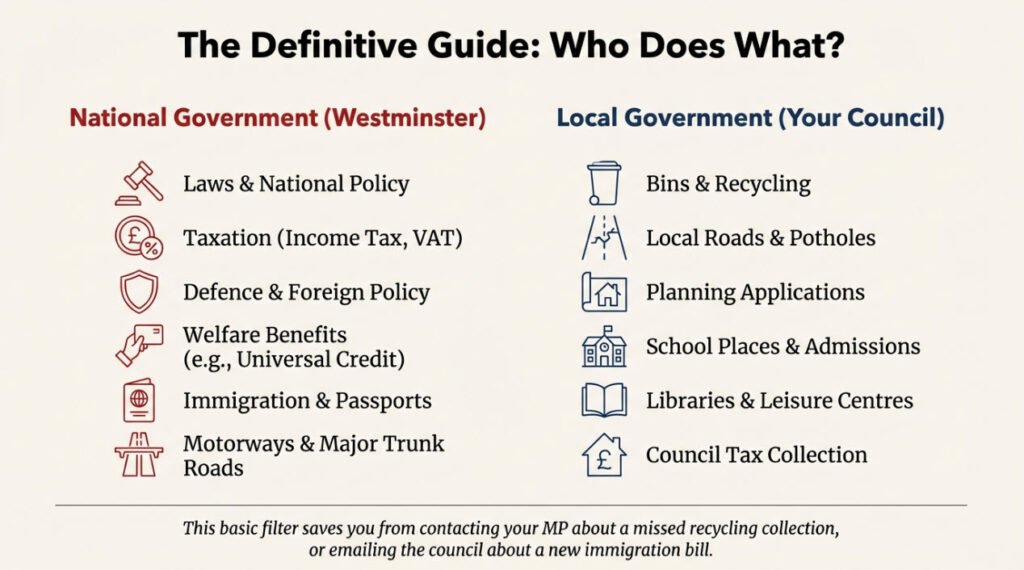
To make it crystal clear, here’s a quick-reference guide to help you instantly categorise your problem. If you're dealing with bins, local parks, streetlights, or library services, your council is your first port of call. For matters concerning national policy like Universal Credit assessments, passport applications, or motorway maintenance, you're looking at a national government department.
This basic filter saves you from the frustration of contacting your MP about a missed recycling collection or emailing the council about a new immigration bill. Now, you might be thinking, 'But my council's website is still a maze!' – and you'd be right. Here's where it gets trickier, especially in England. The UK isn't just split into two neat boxes; local government itself has different structures.
England operates a confusing patchwork of two-tier systems (where a County Council and a District Council share responsibilities), unitary authorities (a single council does everything), and combined authorities with elected mayors. Scotland and Wales are simpler, with fully unitary systems nationwide. This structural jigsaw is a major reason for the public's confusion.
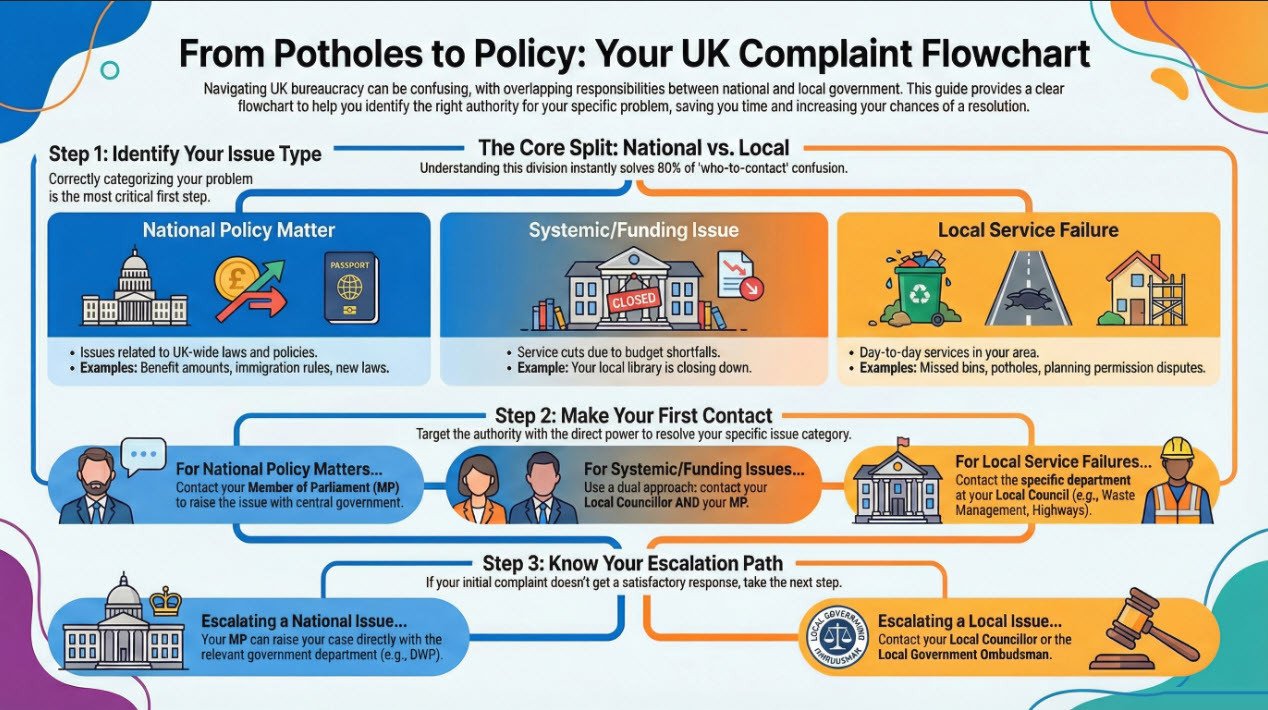
So, how do you navigate this without a degree in public administration? That's where our decision-tree flowchart comes in. Think of it as your shortcut through the bureaucratic fog. By asking a few simple, yes-or-no questions about your problem, the flowchart will guide you straight to the correct authority's doorstep, whether it's your local District Council's waste department or a specific national agency like the DWP. This method is designed to bypass the blame-shifting and get your complaint to the right desk on the first try, saving you hours of research and significantly boosting your chances of a speedy resolution.
Therefore, effectively complaining requires knowing not just who *provides* a service, but who ultimately controls its funding and rules. This understanding leads directly into a step-by-step process for action.
*Sources: Local government in England, Scotland and Wales*
What Is the Step-by-Step Flowchart to Complain to the Right UK Authority?
Let's break down the confusing maze of UK governance into a simple, step-by-step guide. The first and most important step is to correctly identify your problem.
Is it a Local Service issue like a missed bin collection, a dangerous pothole, or a disputed planning application?
Or is it a National Policy matter, such as a change to your benefit amount, an immigration application, or a new law?
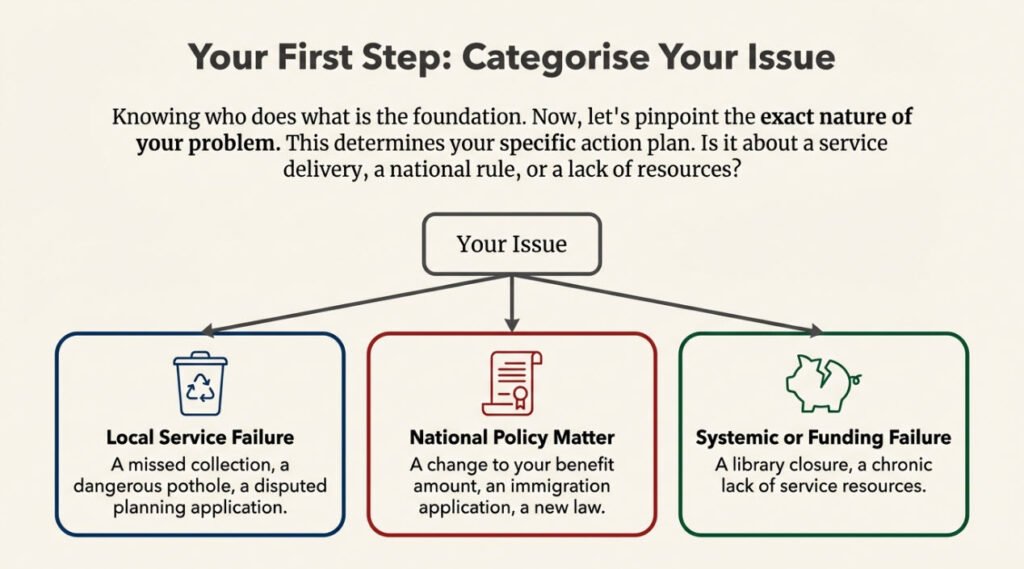
Finally, some problems are about Funding or Systemic Failure, like a local library closure or a severe, chronic lack of resources in a service. Categorising your issue here is the key to the whole process. Remember, starting with the wrong authority just wastes everyone's time.
If your problem is a Local Service, your first port of call is always your specific local council. You need to contact the right department directly: the Waste Management team for bin issues, the Highways Department for potholes, or the Planning Department for disputes. The public generally has higher trust in local councils to handle these matters, so it's best to begin there using their official complaints procedure.
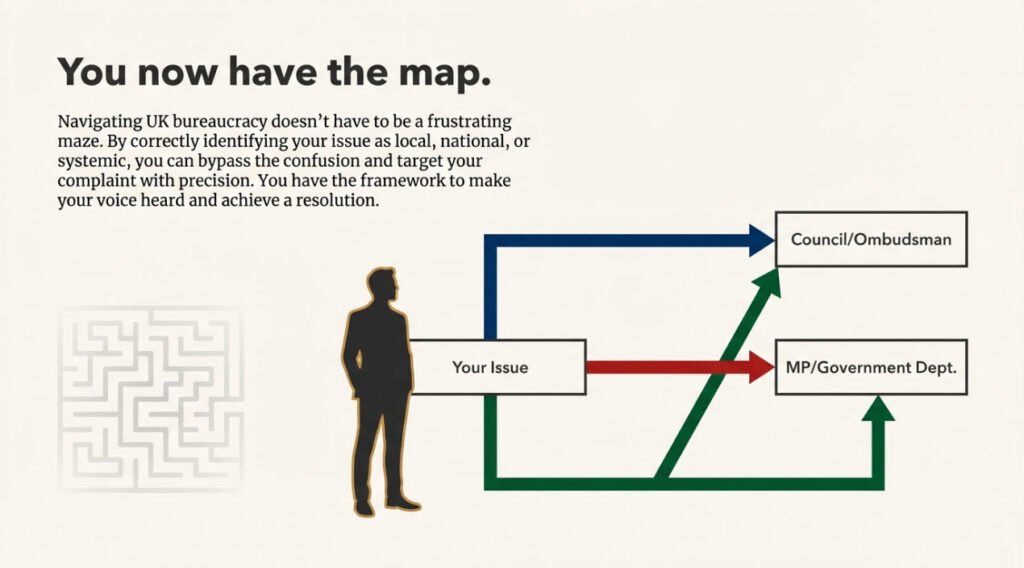
If you get no satisfactory resolution from the council officers, your next step is to escalate. For issues about how a service is run locally, contact your Local Councillor. For a formal complaint about maladministration or unfair treatment, you can take the matter to the Local Government Ombudsman.
For National Policy issues, your MP is the primary point of contact. They can raise your case with the relevant central government department, such as the Department for Work and Pensions (DWP) for benefits or the Home Office for immigration. It's important to know that your MP typically cannot intervene in purely operational matters decided by your local council, like a specific planning decision or a missed bin round. Their power lies in influencing national law and policy.
The trickiest complaints often involve Funding or Systemic Failure. This is where the 'blame-shift' dynamic is most frustrating. Local councils deliver most frontline services, but national government controls the majority of their funding. When a service is cut due to budget constraints, the council points to a lack of central funding, while the government points to local spending choices.
Your best strategy is a dual approach: contact your Local Councillor to report the specific local impact and demand action, and simultaneously contact your MP to complain about the national funding policy that created the shortfall.
To make any complaint effective, keep your communications clear, factual, and documented. Always use the official council or department complaint procedure before escalating to a councillor, MP, or ombudsman. Understanding the fundamental divide between who has the power to make policy and who controls the money will help you target your complaint to the right place, saving you effort and increasing your chances of a meaningful response.
*Sources: Local Government in England, Scotland and Wales*
National vs. Local UK Authority: Who Does What?
| National Government (Westminster) | Local Government (Your Council) |
| Laws & National Policy | Bins & Recycling |
| Taxation (Income Tax, VAT) | Local Roads & Potholes |
| Defence & Foreign Policy | Planning Applications |
| Welfare Benefits (e.g., Universal Credit) | School Places & Admissions |
| Immigration & Passports | Libraries & Leisure Centres |
| Motorways & Major Trunk Roads | Council Tax Collection |
Frequently Asked Questions
Who do I contact about my missed bin collection?
This is almost always your local council's responsibility. You should visit your council's website and look for the 'Waste and Recycling' or 'Bins' section to report a missed collection.
Why are there so many different types of councils?
The structure varies across the UK. England has a mixed system (county, district, and unitary councils), which can be confusing. Scotland and Wales operate simpler, fully unitary systems where one council provides all local services.
If it's a problem with a national policy, like a benefits payment, should I contact my MP or a government department?
For individual casework regarding a government department (like the DWP for benefits), contacting the department directly is the official route. Your MP can often help escalate an issue if you're not getting a response, but the department itself is the primary resolver.
My MP said they can't help with my council planning dispute. Why is that?
MPs are responsible for national law and policy, not the day-to-day operations of your local council. Specific planning decisions, bin collections, and local road repairs are executive functions of the council. Your MP has no authority to overturn these decisions, so their correct advice is to direct you to your local councillor or the council's complaints process.
Who should I contact about my library closing down?
This is a classic funding/systemic issue. You should contact both your Local Councillor (to highlight the local impact and challenge the council's spending priorities) and your MP (to complain about the national funding settlements to local government that force such cuts). This dual approach addresses both sides of the problem.
What's the difference between complaining to a council officer and a local councillor?
Council officers are the paid employees who run services day-to-day. Your first formal complaint should go through the council's official procedure, handled by officers. A local councillor is an elected representative. You escalate to them if the officers' response is unsatisfactory, as they can politically scrutinise and challenge the council's administration and decisions.
Conclusion
Navigating UK bureaucracy to lodge an effective complaint hinges on one key insight: correctly identifying whether an issue is local, national, or systemic. By applying the basic National vs. Local filter and following the structured flowchart, you can bypass confusion and target your complaint precisely.
Recommendations:
• Always start by categorising your issue: Local Service, National Policy, or Funding/Systemic Failure.
• Follow the official complaints procedure of the relevant council or government department first.
• For stalled or unresolved issues, know your escalation path: local councillor for local matters, your MP for national issues, and a dual approach for funding problems.
Sources
1. Local Government in England, Scotland and Wales
*This article is for informational purposes only and does not constitute financial, legal, or professional advice.*
If you want assistance with this article, please Contact Us
