Audio Summary:
If you’ve ever wondered who is responsible for fixing potholes, collecting your bins, or running local schools, you’ve stumbled into the sometimes-confusing world of UK local government. The system varies across England, Scotland, Wales, and Northern Ireland. In many parts of England, public services are split between two main tiers: County Councils and District Councils.
This two-tier system isn't universal. Major cities and some regions have Unitary Authorities that combine all these functions. However, for around 60% of the English population living in non-metropolitan areas, understanding the county vs. district split is key to knowing who to contact for what.
Let’s demystify these two layers of local governance.

The Big Picture: The Two-Tier System of Local Government
Think of it like a pyramid of responsibility:
- Central Government (Westminster): Sets national policy, laws, and major funding.
- County Council: The strategic, upper-tier authority covering a large geographic area (e.g., Hampshire, Lancashire, Kent). They handle large-scale, county-wide services.
- District Council (also known as Borough or City Council): The lower-tier authority within the county, covering a smaller, more local area (e.g., Winchester District within Hampshire, or Lancaster City within Lancashire). They handle more local, community-focused services.
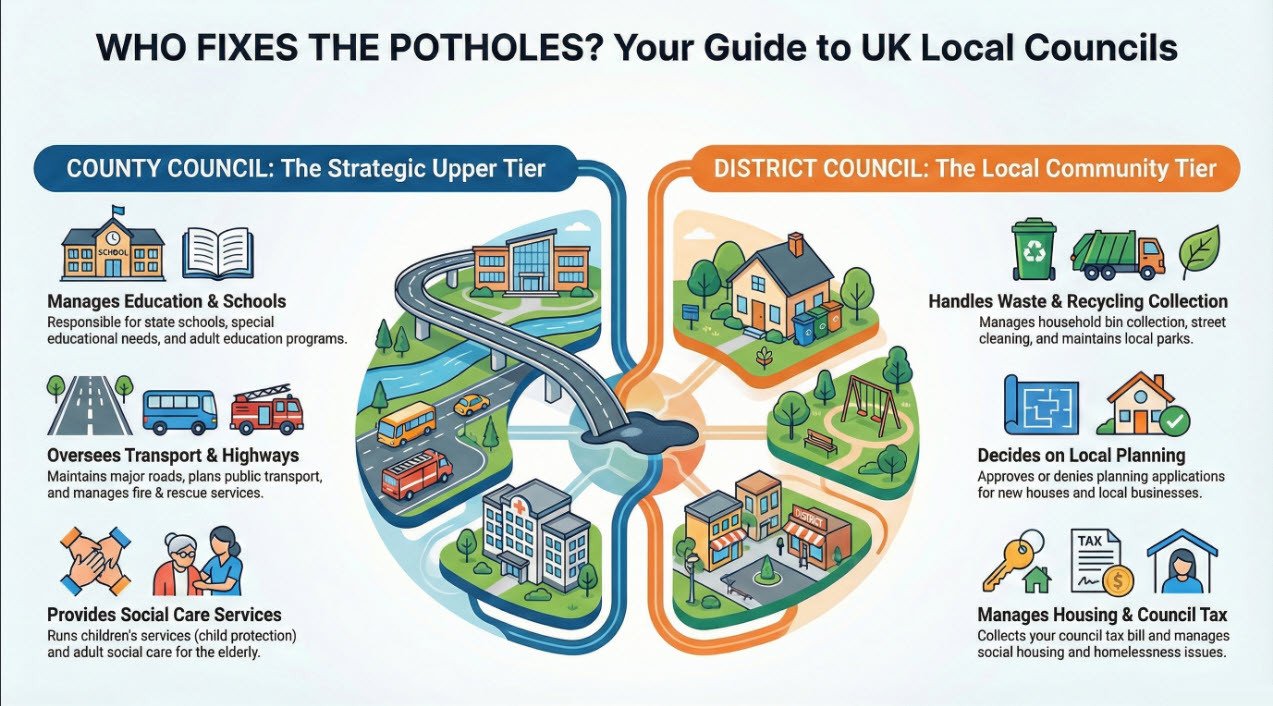
County Council: The Strategic Upper Tier of Local Government
County Councils are responsible for "big picture" services that benefit from strategic planning over a wide area.
Key Responsibilities:
- Education: Running state schools, special educational needs (SEN) provision, and adult education.
- Transport & Highways: Maintenance of most roads and highways, public transport strategy, and issuing parking permits.
- Social Care: Adult social care for the elderly and disabled, and Children’s Services (child protection, fostering, and adoption).
- Strategic Planning: Strategic planning in specific areas such as transport, minerals, and waste, alongside advisory input into district-wide development frameworks.
- Fire & Rescue Service: Operation of the fire service.
- Libraries & Archives: County library services.
- Waste Management: Strategic waste disposal and recycling centres (tips/dumps).
In short: If it’s a large-scale, strategic, or specialist care service, it’s likely under the County Council.

District Council: The Local Community Tier
District Councils are your most local tier of government, focused on the immediate environment and community of your town or district.
Key Responsibilities:
- Housing: Managing social housing, providing housing benefits, and addressing homelessness.
- Planning Applications: Deciding on planning permissions for houses, business developments, and enforcing planning rules.
- Local Environment & Services: Collecting household waste (bins) and recycling, cleaning streets, and maintaining parks and leisure centres.
- Council Tax Collection: The bill you receive comes from this tier (though it includes a precept for the County Council).
- Licensing: Issuing licenses for pubs, restaurants, taxis, and events.
- Local Regulations: Enforcing environmental health rules in businesses and dealing with noise complaints.
In short: If it directly affects your street, home, or local business premises, the District Council is usually your first port of call.
How They Work Together (And Where They Overlap)
While their roles are distinct, collaboration is essential. For example:
- Waste: The District Council collects your black and recycling bins. The County Council is responsible for the disposal and processing of that waste at its facilities.
- Planning: The County Council sets a broad strategic plan for where major developments (like thousands of new homes) should go. The District Council then evaluates and approves or rejects individual planning applications within that framework.
The Exception: Unitary Authorities
In many urban areas (like all of Scotland, Wales, major English cities, and counties like Cornwall and Northumberland), the two-tier system was abolished. Here, a single Unitary Authority performs all the functions of both the County and District Council. This is designed to streamline decision-making and reduce costs.

Why Does This Matter to You?
- Getting Things Done: Knowing which council is responsible saves time when reporting issues. Use a pothole on a main road? Contact the County Council. Issue with bin collection? Contact your District Council.
- Democracy & Accountability: You have separate elected councillors for each tier. Understanding their roles helps you hold the right people accountable for services.
- Council Tax: Your bill is a combined charge, but you can see how much is allocated to each council, police, and fire service, clarifying where your money goes.
Sources & Further Reading
- UK Government Official Guidance: Types of council in England – A definitive breakdown from the government.
- Local Government Association (LGA): About local government – The national membership body for local authorities, providing detailed explanations of roles and structures.
- Legislation: The Local Government Act 1972 established the modern two-tier system in England and Wales, though it has been significantly amended by later acts creating Unitary Authorities.
Conclusion
The UK's local government structure, particularly the division between County and District Councils, is a historical system designed to balance strategic oversight with local responsiveness. While it can seem complex, the division of labour is logical: County for the wide-reaching, strategic services, and District for the hyper-local, community-focused ones. Next time you see an issue in your community, you’ll be better equipped to challenge decisions, demand accountability, integrity and navigate local power effectively. (Tenets of our mission statement).
Check your local council website for the most specific and up-to-date information on services in your area.
If you want assistance with this article, please Contact Us
