Introduction
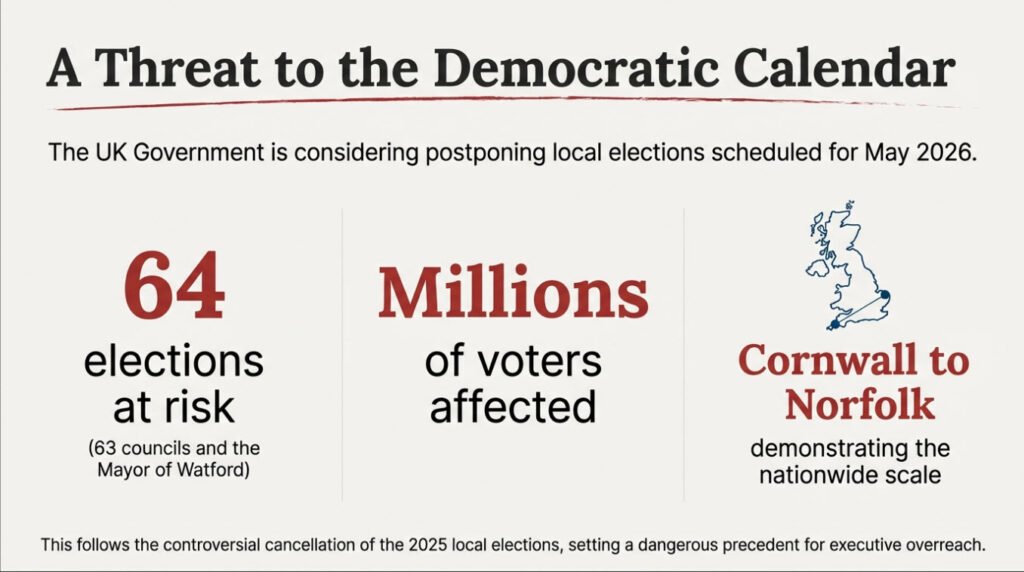
The fabric of British democracy faces a potential tear. In an unprecedented move, the UK Government is considering postponing local elections scheduled for May 2026 across 63 councils and the Mayor of Watford, affecting millions of voters from Cornwall to Norfolk. This proposal, following the controversial cancellation of 2025 local elections, raises profound constitutional, legal, and democratic questions. Is this lawful? What precedent does it set? And crucially, what can citizens do to protect their fundamental right to vote? This post delves into the brewing crisis, examining the reasons why these elections must proceed and the mechanisms available to challenge their postponement.
The Proposed Local Election Postponement: What We Know
The government has cited "boundary reviews and electoral administration efficiency" as the primary justification for considering this delay. The listed authorities—including major councils like Essex County Council, Hampshire County Council, and cities like Plymouth, Southampton, and Portsmouth—would see their electoral cycles extended without a direct public mandate.
This follows the controversial cancellation of the 2025 local elections, which was pushed through via secondary legislation—the 2024 Local Government (Postponement of Elections) Order. That move, justified by the need to align with a new constituency boundary review, set a worrying precedent for executive overreach into the democratic calendar.
CLICK HERE to download the list of proposed cancelled local elections
The Legal and Constitutional Question: Is This Lawful?
Legally, the government possesses the power to postpone local elections through secondary legislation (Statutory Instruments) under acts like the Local Government Act 1972 and the Representation of the People Act 1983, as amended. However, "lawful" does not automatically mean "constitutionally proper" or "democratically legitimate."
Key Legal Concerns:
- Precedent of 2025: The 2025 postponement created a template. It demonstrated that the government can bypass full parliamentary scrutiny (as Statutory Instruments are rarely amended or rejected) to alter the democratic schedule. Legal scholars, such as Professor Alison Young of Cambridge University, argue that while technically within the "letter of the law," such actions stretch constitutional conventions to their limit, using administrative convenience to override a core democratic principle: regular elections.
- Violation of Democratic Rhythm: The UK's uncodified constitution relies heavily on conventions. One of the most sacred is that governments do not interfere with the fixed electoral timetable for political or administrative convenience. The Fixed-term Parliaments Act 2011 (now repealed) reflected this principle for Westminster. Applying a different, cavalier standard to local government suggests a troubling hierarchy of democracy.
- Potential for Judicial Review: A postponement of local elections could be challenged in the courts on grounds of "Wednesbury unreasonableness"—that the decision is so unreasonable no reasonable authority would have made it. Given the scale (64 elections) and the cumulative impact of two consecutive years of disruption, claimants could argue it disproportionately infringes on the right to free elections under Article 3 of Protocol 1 of the European Convention on Human Rights, incorporated into UK law by the Human Rights Act 1998.
Why The Local Elections Must Not Be Cancelled: Democratic and Political Imperatives
1. Accountability and the "Democratic Deficit"
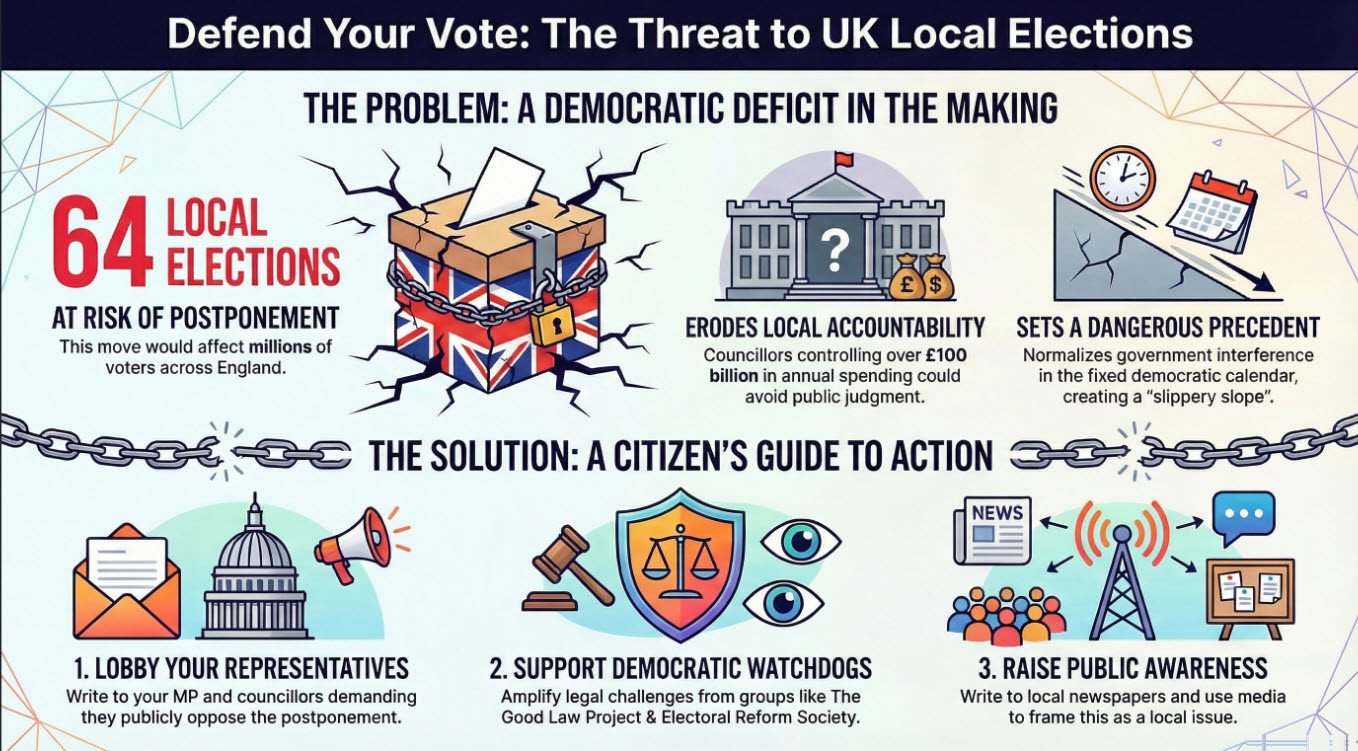
Local councils control over £100 billion in annual spending on vital services: social care, housing, roads, libraries, and waste collection. Delaying elections by a year creates a "democratic deficit" where councillors making crucial decisions are not accountable to the public at their expected time. In councils like Thurrock or Slough (which faced effective bankruptcy), oversight is paramount. Postponement shields failing administrations from electoral consequences.
2. Eroding Trust in Democracy
Voter trust is at a low ebb. The Hansard Society's 2023 Audit of Political Engagement reported record levels of dissatisfaction with the system. Cancelling elections—a tangible act of disenfranchisement—fuels alienation and the perception that those in power are changing the rules to suit themselves. It tells citizens their vote is disposable.
3. Stifling Political Renewal and Representation
Local elections are a pipeline for new political talent and a mechanism for issue-based representation. Delaying them stifles renewal, entrenches incumbents, and denies communities the chance to respond to new challenges—be it the cost-of-living crisis in Hyndburn or coastal management in Isle of Wight.
4. The Slippery Slope Argument
If 2025 and 2026 can be postponed, what about 2027? The precedent normalizes interruption. As Lord Norton of Louth, a constitutional expert, warned in the House of Lords debates on the 2025 order: "We tread on dangerous ground when we start moving away from fixed-term elections… it becomes a habit."
5. Undermining Local Mandates
Many councils, such as Cambridge or Norwich, have declared climate emergencies or are pursuing major local plans. Their mandate, derived from the last election, becomes increasingly stale. Governing without a current mandate weakens the legitimacy of contentious decisions.
What Can the British Public Do? A Guide to Action
Democracy is not a spectator sport. Here is how citizens, community groups, and activists can resist this postponement.
1. Lobby Your MP and Councillors
- Action: Write to your MP and local councillors in the affected authorities. Demand they publicly oppose the postponement and commit to voting against any enabling Statutory Instrument.
- Key Argument: Emphasize that local democracy should not be sacrificed for central administrative convenience. Use the list of 64 elections to make it specific: "As a constituent in [e.g., Southend-on-Sea], I demand my right to vote in May 2026."
- Tool: Use platforms like TheyWorkForYou to find contact details and track your representative's voting record.
2. Support and Amplify Legal Challenges
- Action: Watch for groups like The Good Law Project, Electoral Reform Society, or local campaigners launching legal actions or crowdfunding for judicial review.
- Key Argument: Financial and public support for such cases is crucial. Share their campaigns and donate if possible.
3. Engage with the Formal Consultation Process
- Action: If, as with the 2025 order, the government launches a formal consultation, respond to it. Mobilize local community groups, resident associations, and political parties (across the spectrum) to submit evidence.
- Key Argument: In consultations, substantive arguments matter. Cite the democratic principles and practical harms of delay, don't just express opposition.
4. Utilise Media and Public Awareness
- Action: Write to local newspapers (e.g., Ipswich Star, Peterborough Telegraph, Plymouth Herald). The postponement is a national story made of 64 local stories. Highlight what's at stake in your community.
- Key Argument: Frame it as "Whitehall silencing your town hall." Local media coverage creates pressure on local MPs.
5. Join and Support Democratic Watchdogs
- Action: Support organizations that defend democratic norms.
- Electoral Reform Society: Campaigns for a better democracy.
- Unlock Democracy: Focuses on citizen power and constitutional rights.
- Local Government Information Unit (LGIU): Champions local democracy.
- Their research, lobbying, and campaigns provide the backbone for public opposition.
6. Prepare for Direct Action
- Action: If the postponement is enacted, peaceful democratic protest is a fundamental right. Organize local rallies, demonstrations at town halls, and public debates under banners like "Defend Our Vote."
- Key Argument: Make the invisible visible. Show that the disenfranchised are real people who care about their communities.
Conclusion: A Line in the Sand
The proposed postponement of the May 2026 local elections is not a minor administrative adjustment. It is a significant erosion of democratic accountability that follows a dangerous precedent set in 2025. While it may be maneuvered through a technical legal pathway, its constitutional legitimacy is deeply flawed.
The councils at risk—from Adur to Worthing—represent the everyday governance of Britain. Denying their residents a vote denies them a voice in their own communities' futures. The reasons to resist are clear: to uphold accountability, maintain trust, and protect the principle that no government should have the unchecked power to silence the electorate.
The British public is not powerless. Through determined lobbying, legal scrutiny, public pressure, and collective action, this decision can be challenged. The choice is whether we accept the quiet cancellation of local democracy or stand to defend it. The time to act is now, before the postponement is a fait accompli. Let 2026 be the year we drew a line in the sand.
Sources and Further Reading:
- UK Parliament. Local Government (Postponement of Elections) Order 2024 - Debate transcripts.
- Electoral Commission. Reports on the Administration of Local Elections.
- Hansard Society. Audit of Political Engagement 2023.
- The Constitution Unit, UCL. Analysis on Local Government Democracy.
- The Good Law Project. Legal Challenges on Democratic Issues.
- House of Lords Constitution Committee. Reports on Electoral Law.
- Local Government Association (LGA). Briefings on Electoral Cycles.
- The Guardian, BBC, and Local Newspaper Archives on the 2025 postponement.
Disclaimer: For important information regarding the sourcing, purpose, and limitations of this content, please refer to the full disclaimer located in the footer of this website.
If you want assistance with this article, please Contact Us