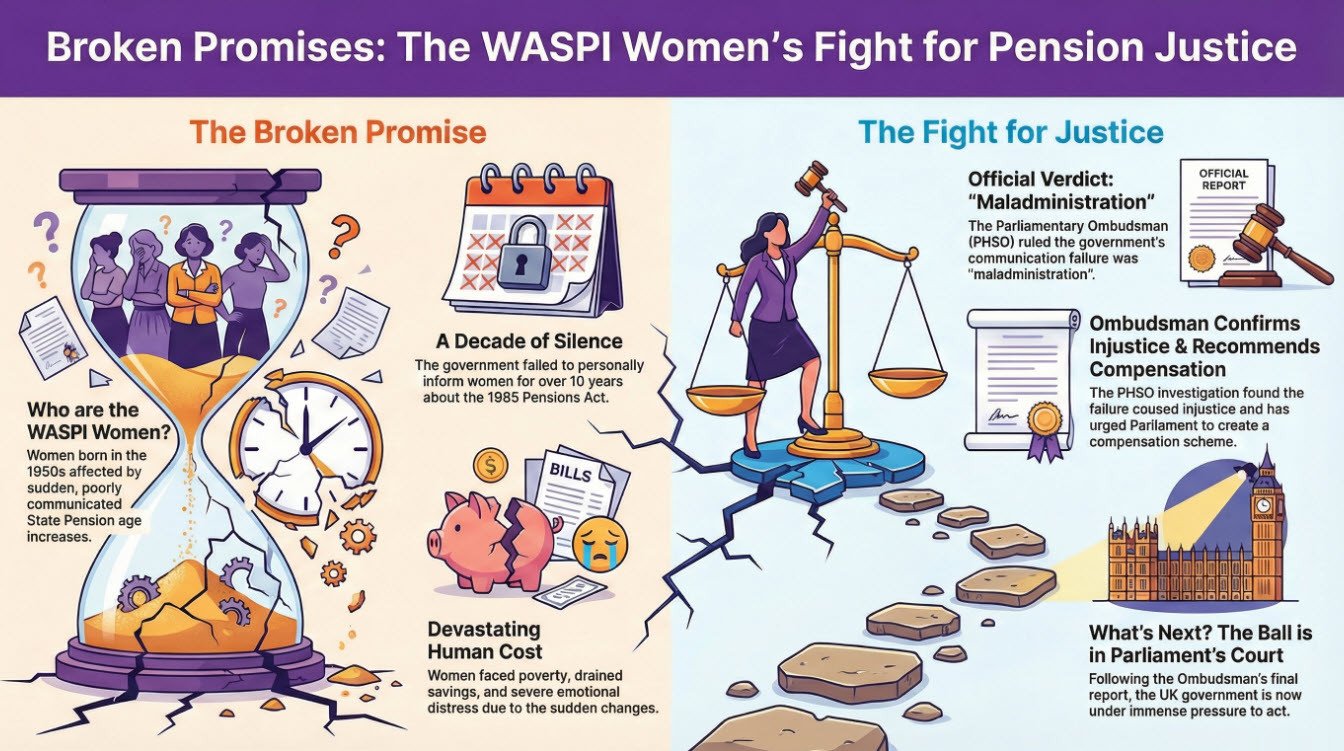
The WASPI Women: A Story of Promises Broken and a Fight for Justice
For nearly a decade, a determined group of women has been at the forefront of one of the UK's most significant battles over pension rights. They are the "WASPI" women—Women Against State Pension Inequality. Born in the 1950s, they represent a generation who saw their retirement plans shattered by government changes to the state pension age, changes they say were communicated with a profound and devastating lack of notice.
This isn't just a story about policy; it's a story about lives upended, financial security destroyed, and a relentless fight for fairness. In this deep dive, we'll explore the origins of the WASPI issue, the human cost behind the headlines, the latest legal and political developments, and what compensation could potentially look like.
What is the WASPI Issue? A Timeline of a "Bombshell"
To understand the WASPI campaign, we must first go back to 1995. The Conservative government passed the Pensions Act, which began the process of equalizing the state pension age for men and women, raising it from 60 to 65. This was a monumental shift, but the implementation was slow, and crucially, the communication was a failure.
- 1995 Pensions Act: Began the process of raising women's state pension age from 60 to 65, to be phased in between 2010 and 2020.
- The Critical Failure: For over a decade, many of the women affected received no direct, personal communication from the government informing them of this change. They planned their lives, careers, and retirement savings based on an expectation of retiring at 60.
- The 2011 Acceleration: The Coalition government's Pensions Act of 2011 accelerated the timetable, raising the pension age for both men and women to 66, and later to 67. This meant the hike for women born in the 1950s happened much faster than originally planned.
For many, the first time they learned their pension age had shifted by up to six years was with just a few years' notice—far too late to adjust decades of financial planning.
As the Parliamentary and Health Service Ombudsman (PHSO) stated in its investigation, the Department for Work and Pensions (DWP) "failed to make a reasonable decision about targeting information to the women affected by these changes" and that this failure constituted "maladministration." [Source: PHSO]
The Human Cost: More Than Just Lost Income
While the policy details are complex, the human impact is starkly simple. The sudden change plunged hundreds of thousands of women into financial and emotional crisis.
- Shattered Retirement Plans: Women who had worked physically demanding jobs for 40+ years found they could not afford to retire.
- Plunged into Poverty: Many were forced to drain life savings, take on debt, or rely on benefits to bridge the gap.
- Career Roadblocks: Women in their late 50s and early 60s who were made redundant found it nearly impossible to find new, well-paying employment, facing pervasive ageism and sexism in the job market.
- Health and Wellbeing: The stress and financial strain have been linked to significant mental and physical health declines among affected women.
The WASPI campaign has consistently highlighted these stories—women who became carers for elderly parents or grandchildren, expecting to have a pension to fall back on, and those who took early retirement packages only to find their state pension was years away.

The Legal and Political Battle: Maladministration and the Fight for Compensation
The WASPI campaign has been a masterclass in grassroots activism, keeping the issue in the national spotlight for years. Their key argument is not against the principle of equalization, but against the unfair and poorly communicated way it was implemented.
The most significant development has come from the Parliamentary and Health Service Ombudsman (PHSO). In a landmark ruling, the Ombudsman found the DWP guilty of maladministration for its failure to adequately inform the women.
The investigation has progressed through three stages:
- Stage 1: Maladministration - Confirmed. The DWP failed to act promptly and provide accurate information.
- Stage 2: Injustice - Confirmed. This failure led to significant personal injustice, including financial loss and emotional distress.
- Stage 3: Compensation - The Final Hurdle. The Ombudsman has completed this stage, concluding that the women are owed compensation. It has now asked Parliament to intervene and create a compensation scheme, having found the DWP's response to its recommendations inadequate. [Source: PHSO]
This places immense pressure on the UK government to act. Cross-party MPs have supported the cause, and several compensation proposals have been tabled, ranging from one-off lump sums of £10,000 or more to ongoing monthly payments.
What's Next? The Road to Redress
As of 2024, the ball is firmly in Parliament's court. The PHSO has done its job, and it is now up to our elected officials to create a redress scheme. The government can no longer hide behind an ongoing investigation.
The campaign continues with undiminished vigor. WASPI women and their supporters are lobbying MPs, holding rallies, and ensuring that their story is not forgotten. The question is no longer if an injustice occurred, but how and when it will be rectified.
Conclusion: A Debt of Honour
The story of the WASPI women is a cautionary tale about how good policy can be ruined by terrible delivery. A generation of women, who contributed to society their entire lives, were failed by the system they paid into. They were denied the time, dignity, and financial security in retirement they were promised and had earned.
Compensation is not a handout; it is a matter of justice. As a society, we have a debt of honour to these women to acknowledge the harm done and provide a fair and swift resolution. The fight for the 1950s women is a fight for the basic principle that a government's word must be its bond.
if you require assistance with this article, please contact us.
Please see our disclaimer.
Sources Cited:
- Women Against State Pension Inequality (WASPI) Campaign. Official Website. [Link: https://www.waspi.co/]
- Parliamentary and Health Service Ombudsman (PHSO). Investigation into the Department for Work and Pensions' communication of State Pension age changes. Various Reports (2021-2024). [Link: https://www.ombudsman.org.uk/complaints-waspi-women]
- UK Government. Pensions Act 1995 and Pensions Act 2011. [Link: https://www.legislation.gov.uk/]
- House of Commons Library. The Pensions Act 2011 and the rise in the State Pension age to 66 for men and women (Briefing Paper CBP-06145). [Link: https://researchbriefings.files.parliament.uk/documents/CBP-6145/CBP-6145.pdf]
